
Why Offshore Buoys and Inshore Apps Show Different Sea Temperatures
Offshore buoy sea temperature readings often differ from inshore apps — understanding why can help anglers interpret conditions much more effectively.
If you’re anything like me, you’re constantly watching conditions — and at this time of the year, especially the water temperature.
The other morning, I compared two readings from the same general area:
Splaugh Buoy (offshore at Rosslare)
Nautide App (inshore reading for Rosslare)
There was over a 2°C difference between them.
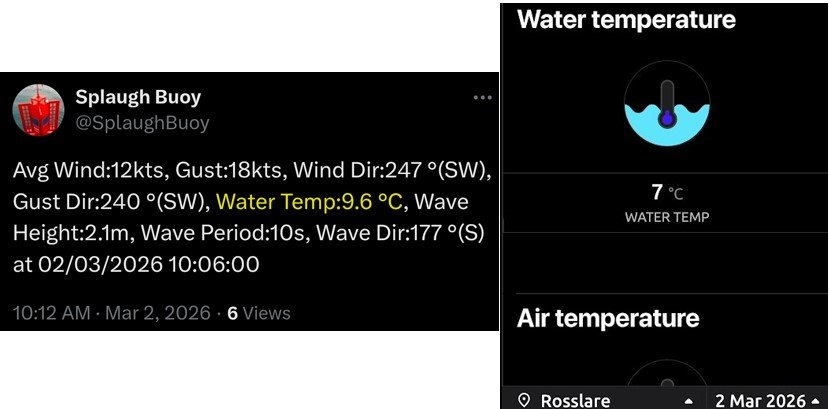
Offshore vs inshore sea temperature readings taken on the same morning.
So what’s going on?
Same Area, Different Water
At first glance it looks confusing. How can two readings taken so close together be that far apart?
The answer is simple: depth and location matter.
Splaugh Buoy sits just over a mile offshore in deeper water. That deeper water:
Holds heat longer
Fluctuates more slowly
Is less affected by direct sunlight
Isn’t influenced as heavily by freshwater runoff
In contrast, inshore water around Rosslare is:
Much shallower
More exposed
Strongly affected by tides
Influenced by rivers and surface cooling
Shallow water reacts faster. It cools faster in winter and warms faster in spring. Offshore water is more stable.
That stability explains the difference.
Measured Data vs Modelled Data
There’s also a technical factor.
Splaugh Buoy is constantly measuring conditions using physical sensors in the water column.
Apps like Nautide are very good — and useful — but they often use a combination of:
Modelled data
Rounded figures
Satellite input
Coastal estimates
That doesn’t make them wrong. It just means they serve a slightly different purpose.
Which One Should You Trust?
The real answer is: both — but for different reasons.
Splaugh tells you what the wider sea is doing and how quickly it’s warming overall.
Inshore readings give you a better indication of what you’ll actually experience on the shoreline.
If you fish from the shore (like most of us in Wexford do), that inshore temperature often matters more in the short term.
Why 2°C Matters for Bass
Two degrees doesn’t sound like much.
But in late winter and early spring, it can mean the difference between:
Fish still being lethargic in cold water
Or fish beginning to feed more confidently
As a rough guide, once inshore temperatures consistently move into the 10–11°C range, bass activity generally starts to improve noticeably.
Right now, if offshore is reading close to 10°C but inshore is sitting at 7–8°C, that tells you something important:
The sea is warming — but the shoreline may not be there yet.
Understanding that difference helps you decide:
Where to fish
How to fish
And what expectations to bring with you
What Each Reading Is Telling You
Neither reading is wrong — they’re simply showing different parts of the same system.
Offshore buoys like Splaugh give a clear indication of how the wider sea is behaving and how quickly conditions are changing.
Inshore readings, on the other hand, reflect the water that’s directly influencing the marks we fish from the shore.
Looking at both together gives a far better understanding of what’s actually happening along the coast.
And at certain times of year — particularly in late winter and early spring — even a small difference between the two can be significant.
Sometimes that 2°C difference explains why the sea looks promising but the fishing still feels slow — when the water is cold, slowing everything down and keeping your lure working close to the bottom will often give you the best chance.
Small details like this are often what make the difference between simply fishing and consistently catching bass and are details we cover during guided fishing sessions on the Wexford Coast.